- Feb 19, 2026
- Ravi Enviro
- RO Plant
- 0 Comments
Reverse Osmosis (RO) technology has become one of the most widely used water purification methods across residential, commercial, and industrial sectors. However, not all RO systems are the same. Industrial RO plants, Commercial RO systems, and Domestic RO units are designed for very different purposes, capacities, and water quality requirements. Understanding the key differences between these RO systems helps in selecting the right solution for long-term reliability and efficiency.
Understanding Industrial RO, Commercial RO & Domestic RO
What Is an Industrial RO Plant?
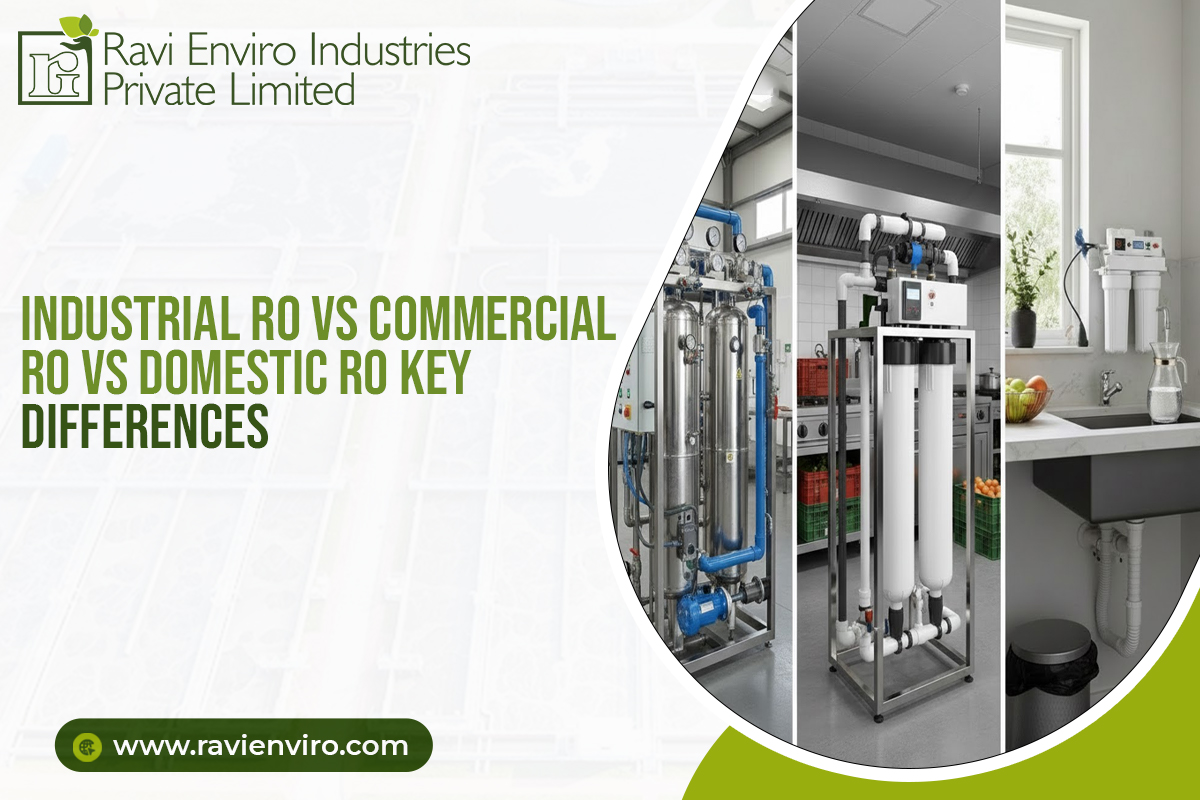
Industrial RO plants are engineered for high-capacity, continuous-duty applications where water quality directly impacts production, equipment life, or regulatory compliance.
At Ravi Enviro Industries Pvt.Ltd, as one of the trusted industrial RO plant manufacturers in India, designs these systems based on detailed raw water analysis and end-use requirements.
Check: About Industrial RO Plant Automation
Key Characteristics:
➤ High capacity (from 2,000 LPH to several MLD)
➤ Advanced pretreatment systems (sand filters, carbon filters, softeners, UF)
➤ PLC/SCADA-based automation
➤ High recovery and energy-efficient design
➤ Robust construction for 24/7 operation
➤ Integration with ETP, STP, or ZLD systems
What Is a Commercial RO System?
Commercial RO systems bridge the gap between domestic and industrial requirements. The RO plant company in India designs systems that are built to handle moderate water demand with consistent output quality.
Key Characteristics:
➤ Medium capacity (100–2,000 LPH)
➤ Higher-grade membranes compared to domestic RO
➤ Better pretreatment systems
➤ Continuous operation capability
➤ Semi-automatic or automatic controls
Read: What is an Industrial DM RO Water Treatment Plant?
What Is a Domestic RO System?
Domestic RO systems are designed for household drinking water purification. These systems focus on removing dissolved salts, bacteria, viruses, and contaminants from municipal or borewell water to make it safe for daily consumption.
Key Characteristics:
➤ Low capacity (typically 10–25 LPH)
➤ Compact, wall-mounted or under-sink design
➤ Basic pre-filtration (sediment + carbon filters)
➤ Minimal automation
➤ Designed for intermittent use
| Industrial RO vs Commercial RO vs Domestic RO | |||
|---|---|---|---|
| Parameter | Domestic RO | Commercial RO | Industrial RO |
| Capacity | 10–25 LPH | 100–2,000 LPH | 2,000 LPH to MLD |
| Usage | Drinking water | Institutional use | Process & production |
| Operation | Intermittent | Semi-continuous | Continuous (24/7) |
| Automation | Manual/basic | Semi-automatic | Fully automatic (PLC/SCADA) |
| Pretreatment | Basic | Moderate | Advanced & customized |
| Design Life | Short to medium | Medium | Long-term industrial duty |
| Maintenance | Low | Moderate | Professional O&M required |
Conclusion
Domestic, commercial, and industrial RO systems may use the same core technology, but their design philosophy, capacity, and performance expectations are entirely different. Understanding these differences is essential to making the right investment. If you are planning to install or upgrade an RO system, partnering with an experienced manufacturer like Ravi Enviro Industries Pvt. Ltd. ensures the solution is tailored to your actual requirements, not just your water source.
Why Choose REIPL for RO Plant Solutions?
As one of the most experienced reverse osmosis plant manufacturers in India, REIPL offers end-to-end RO solutions, including:
➤ Custom-designed Industrial & Commercial RO plants
➤ In-house manufacturing and testing
➤ Energy-efficient and high-recovery systems
➤ AMC and O&M services
➤ Integration with ETP, STP, and ZLD systems
➤ Reliable after-sales and technical support
Whether you need a commercial RO system or a tailored industrial RO plant, REIPL delivers solutions engineered for performance and durability. Contact REIPL today to discuss the right RO solution for your application.
Also Read: Commercial RO Plant for the Food and Beverage Industry