- May 27, 2024
- Ravi Enviro
- STP
- 0 Comments
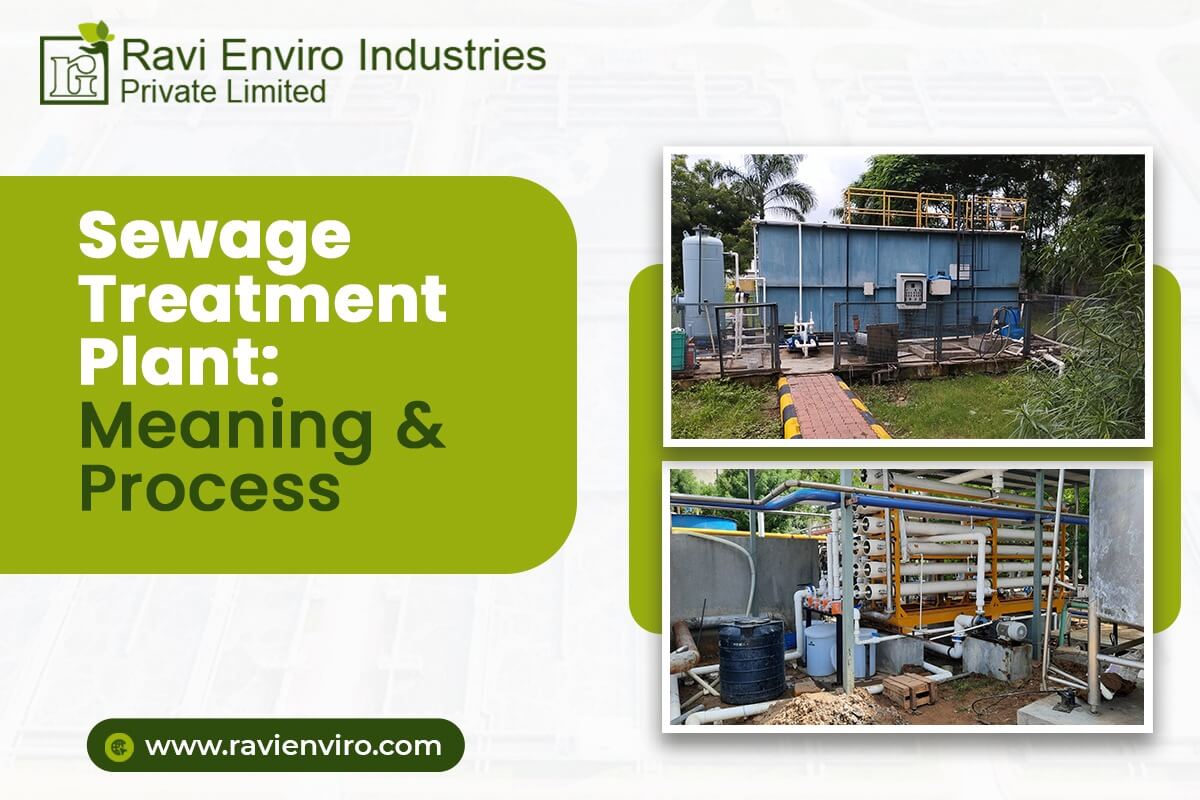
Sewage is wastewater that comprises large amounts of organic and inorganic solids, suspended particles, heavy metals, and other contaminants. Sewage treatment plants remove contaminants, microorganisms, and other pollutants from the wastewater. The STP plants collect, treat, and discharge wastewater to offer a crucial service for environmental and public safety. The growing infrastructural development and water usage for domestic and commercial purposes have resulted in the large generation of wastewater. The importance of sewage treatment plants (STP) has significantly grown to protect public health and prevent pollution. In this, we explore the STP meaning & Sewage meaning, how they work, and their application to shed light on their importance.
STP full form is Sewage Treatment Plant, and the STP meaning refers to a system designed to treat wastewater and sewage before releasing it into the environment or reusing it. Many people ask what is the full form of STP or S.T.P full form, especially in the context of water management. In STP full form in water treatment, it stands for a process that removes pollutants, organic matter, and harmful bacteria from STP water using advanced physical, biological, and chemical methods. In simple terms, STP stands for a facility that ensures safe disposal of sewage, helps prevent water pollution, and supports sustainable wastewater management for residential, commercial, and industrial applications. So let’s understand what is meaning of STP, the STP process, and everything you need to know.
Whether you are looking for an STP plant manufacturer in Gujarat, planning a sewage treatment plant for a housing society, hotel, hospital, or industrial facility — understanding the STP process is the first step. India’s CPCB and State Pollution Control Boards (SPCB) mandate sewage treatment compliance for all urban development projects above a certain population or flow threshold. Ravi Enviro Industries Pvt. Ltd. (REIPL), a trusted STP plant manufacturer in Vadodara with 50+ years of experience, designs and supplies compact MBBR, MBR, SBR, and ASP-based sewage treatment systems across India, from 10 KLD to multi-MLD capacity.
Read Here: How to Select the Right Water Treatment Plant
What Does STP Mean?
The STP full meaning is Sewage Treatment Plant. Sewage comprises wastewater generated from various establishments like households, industries, hotels, and others. STP plants treat this wastewater to make it safe for disposal. The Sewage Treatment Plant process includes physical, chemical, and biological processes to eliminate contaminants and treat them so they are safe to be discharged into the environment. Sewage sludge is the byproduct of the treatment, which is semi-solid and undergoes further treatment for safe disposal.
Importance and Need of STP (Sewage Treatment Plant)
Sewage comprises a high quantity of organic and inorganic waste. It is crucial to treat the contaminants before being disposed of in the natural environment and body waters. If the sewage water is disposed into the water bodies or land, it could pose a major environmental threat and can lead to health hazards. The primary goal of an stp plant manufacturer in India & is to protect human life and the ecosystem by removing contaminants and bacteria from the sewage water for safe disposal.
How Does STP Plant Work?
The Sewage Treatment Plant is a system that is designed to clean and treat wastewater before discharging into the environment. The main objective of the Sewage Treatment Plant process is to remove harmful contaminants and pollutants from the wastewater and make it safe for reuse or disposal, at Ravi Enviro Industries Pvt. Ltd, we emphasize a greener planet through sustainability and an eco-friendly approach. Our standardized package of STP plants with MBBR/FBBR technology leaves fewer carbon footprints and emissions. Our range of STP plants aims to prevent water pollution, protect the ecosystem, and ensure a sustainable supply of clean water.
The STP plant process consists of a few steps. The wastewater runs through different treatment plants to treat the sewage properly.
Also Check: Sewage Treatment Plant supplier in Bharuch & STP plant manufacturer in Goa
Common Sewage Treatment Plant Process
– Moving Bio Bed Reactor (MBBR)
– Membrane Bio Reactor (MBR)
– Activated Sludge Process
– Sequential Bio Reactor (SBR)
– Rotating Bio Reactor
Read: Importance of Sewage Treatment Plants for Industrial Sewage
Following are the Sewage Treatment Plant Process Steps:
Step 1: Preliminary Treatment: The Sewage Treatment Plant process starts with the removal of large solids and particles through grates and screens. This ensures the prevention of damage to the equipment, and smaller particles can be treated in the later stages.
Equipment Used: Bar screens, coarse screens, grit chambers, and skimming tanks. This stage removes rags, plastics, sand, and grit that can damage downstream equipment. Flow measurement and equalization tanks are often included at this stage for uniform hydraulic loading.
Step 2: Primary Treatment: In the primary STP treatment process, the sewage water runs into settling tanks; this allows the solid particles to settle at the bottom as sludge and lighter particles form a layer on the surface. The clear water, known as effluent, is separated from the settled solid particles. The sludged collected is further treated.
Typical BOD Reduction at This Stage: 25–40%. Equipment includes primary clarifiers or settling tanks. Collected sludge is pumped to sludge thickeners or directly to dewatering equipment like a screw press for volume reduction before disposal.
Step 3: Secondary Treatment: In this step, suspended biological and dissolved matter is removed from the wastewater. It involves using indigenous and water-borne organisms like protozoa that feed on contaminants like sugar, food waste, and other pollutants. An additional separation method is employed to remove the microorganism from the water before discharging it.
Secondary treatment achieves 85–95% BOD and COD removal. Technologies deployed at this stage include MBBR (Moving Bed Biofilm Reactor), MBR (Membrane Bio Reactor), SBR (Sequential Batch Reactor), and Activated Sludge Process (ASP). REIPL’s MBBR-based STP systems use Sumitomo PTFE membranes for superior effluent quality.
Step 4: Tertiary Treatment: In the last sewage treatment process step, the water is filtered to get rid of the remaining contaminants. Later, the wastewater is disinfected before releasing it.
Tertiary treatment brings treated water to reuse-grade quality. Methods include sand filtration, activated carbon filtration, UV disinfection, and chlorination. Treated STP water meeting CPCB Class B standards can be reused for garden irrigation, toilet flushing, construction, and cooling towers — reducing freshwater dependency by up to 60%.
Applications of Sewage Treatment Plants
STPs are essential for:
➤ Residential townships
➤ Housing societies
➤ Hotels & resorts
➤ Hospitals
➤ Textile & pharmaceutical industries
➤ Municipal projects
Read Here: STP & ETP Annual Maintenance Checklist
Where to Find Reliable Sewage Treatment Plants in India?
Ravi Enviro Pvt. Ltd is a leading water and wastewater treatment plant manufacturer in India. We are committed to providing innovative solutions to industries to curb pollution and adhere to environmental safety standards. We offer a wide range of STP customized to suit specific requirements at the best prices. Additionally, we provide maintenance services for different WWTPs for our clients. So, whether you need an STP plant, ETP plant, RO plant, Package Plants or turnkey solution for your environmental projects, we’ve got you covered! Contact us today and learn how we can add value to your business.
Also check:- Diverse Types of STP Plants
Get Expert STP Solutions for Your Project
Ravi Enviro Industries Pvt. Ltd. offers customized, energy-efficient STP systems for residential, commercial, and industrial applications. From design to commissioning and AMC support, we deliver complete wastewater treatment solutions tailored to your site requirements. Contact our engineering team today for a consultation and technical proposal.
Check: Operation & Maintenance Contracts — REIPL
Frequently Asked Questions (FAQs)
What is the STP plant full form?
The STP plant full form is Sewage Treatment Plant — a system designed to treat wastewater before discharge or reuse.
What is the difference between STP and ETP?
STP treats domestic sewage from residential and commercial establishments, while ETP (Effluent Treatment Plant) treats industrial wastewater containing chemical contaminants.
How much space is required for an STP plant?
Space depends on capacity and technology. Compact MBBR and MBR systems require less area compared to conventional plants.
What is the cost of installing an STP in India?
STP cost depends on capacity (KLD), technology used, automation level, and site conditions. A technical assessment is required for accurate pricing.
Is treated STP water reusable?
Yes. Treated water can be reused for gardening, flushing, cooling towers, and construction activities, depending on tertiary treatment quality.
Which technology is best for STP?
MBBR and MBR are widely preferred for their efficiency, compact design, and low maintenance requirements. The choice depends on application and discharge standards.
Is STP mandatory for residential societies in India?
Yes. As per CPCB guidelines and many state-level regulations, residential group housing projects generating more than a specified volume of wastewater (typically 10 KLD or more) are required to install an on-site STP. Many municipal corporations and real estate regulatory authorities (RERA) mandate STP compliance as a condition for occupancy certificates.
What are the CPCB discharge norms for STP effluent?
CPCB has specified discharge standards for treated STP effluent. Key parameters include: BOD ≤ 10 mg/L (for discharge into water bodies), COD ≤ 50 mg/L, Total Suspended Solids (TSS) ≤ 10 mg/L, and pH between 6.5–8.5. For reuse in irrigation, higher BOD limits apply. REIPL’s STP systems are designed to consistently meet these norms.
What is the difference between STP, ETP, and WTP?
An STP (Sewage Treatment Plant) treats domestic wastewater from residential, commercial, or municipal sources. An ETP (Effluent Treatment Plant) treats industrial wastewater containing chemical contaminants and heavy metals. A WTP (Water Treatment Plant) purifies raw water for drinking or industrial process use. REIPL designs and manufactures all three types of treatment systems.
How does MBBR technology work in STP?
MBBR (Moving Bed Biofilm Reactor) uses free-floating plastic carriers that provide a large surface area for biological growth. Microorganisms growing on these carriers break down organic pollutants in the wastewater. MBBR systems are compact, energy-efficient, and ideal for housing societies, hotels, and industries with space constraints.
Learn more: What is MBBR Technology in STP Plant?