- Aug 15, 2026
- Ravi Enviro
- Uncategorized
- 0 Comments
In an effluent treatment plant (ETP), even a small human error can have serious consequences. A missed chemical dose, a valve left in the wrong position, a skipped pH check, or a delayed response to a process upset can lead to non-compliance, disrupt biological treatment, or create safety risks. In some cases, all of these issues can occur at once.
Since ETPs operate continuously and rely heavily on manual monitoring and decision-making, the risk of human error is always present. While mistakes cannot be eliminated, their impact can be greatly reduced. As one of the leading effluent treatment plant manufacturers in India, we emphasize the key is to design plant operations so that errors are prevented wherever possible, detected quickly when they occur, and stopped from escalating into major operational or compliance issues. In this article, we explore practical strategies to minimise human error and improve the reliability, safety, and performance of effluent treatment plant operations.
Where Human Error Shows Up in ETP Operations
- Chemical Dosing Mistakes: Using the wrong chemical, adding the wrong dose, or dosing at the wrong time. These errors can disrupt pH control, coagulation, and biological treatment.
- Missed or Inaccurate Monitoring: Skipping routine checks, collecting poor samples, or misreading instruments. Problems can go unnoticed until they become serious.
- Valve & Pump Misoperation: Leaving valves in the wrong position, running pumps dry, or routing flow incorrectly. These mistakes can interrupt treatment and damage equipment.
- Delayed Response to Process Failures: Failing to react quickly to sudden changes, such as a pH fluctuation or an increase in organic load. Small issues can quickly escalate into major process failures.
- Poor Sludge & Equipment Management: Delaying desludging or neglecting routine maintenance. This reduces treatment efficiency and increases the risk of breakdowns.
- Record-keeping Errors: Incomplete or inaccurate logbooks and shift records. Missing data can hide operational trends and make compliance reporting more difficult.
- Safety Lapses: Improper handling of chemicals or unsafe practices during confined-space work. These errors carry the highest risk to both personnel and plant operations.
How to Eliminate Human Error in Effluent Treatment Plant Operations
1. Build Clear SOPs & Checklists
Clear Standard Operating Procedures (SOPs) turn expert knowledge into consistent, repeatable processes that every operator can follow, regardless of experience or shift. Pair these SOPs with simple checklists for start-up, shift handovers, chemical dosing, and shutdown procedures to ensure critical steps are never missed or left to memory. Easy to implement and highly effective, checklists are among the most reliable tools for reducing human error and improving operational consistency.
2. Invest in Training & Competency
Even the best procedures are only effective if operators know how to apply them. Regular, hands-on training helps operators understand the treatment process, use equipment correctly, and respond confidently to process upsets. Ongoing refresher training reinforces good practices, keeps skills up to date, and ensures competency is maintained.
3. Automate Tasks That Are Error-Prone
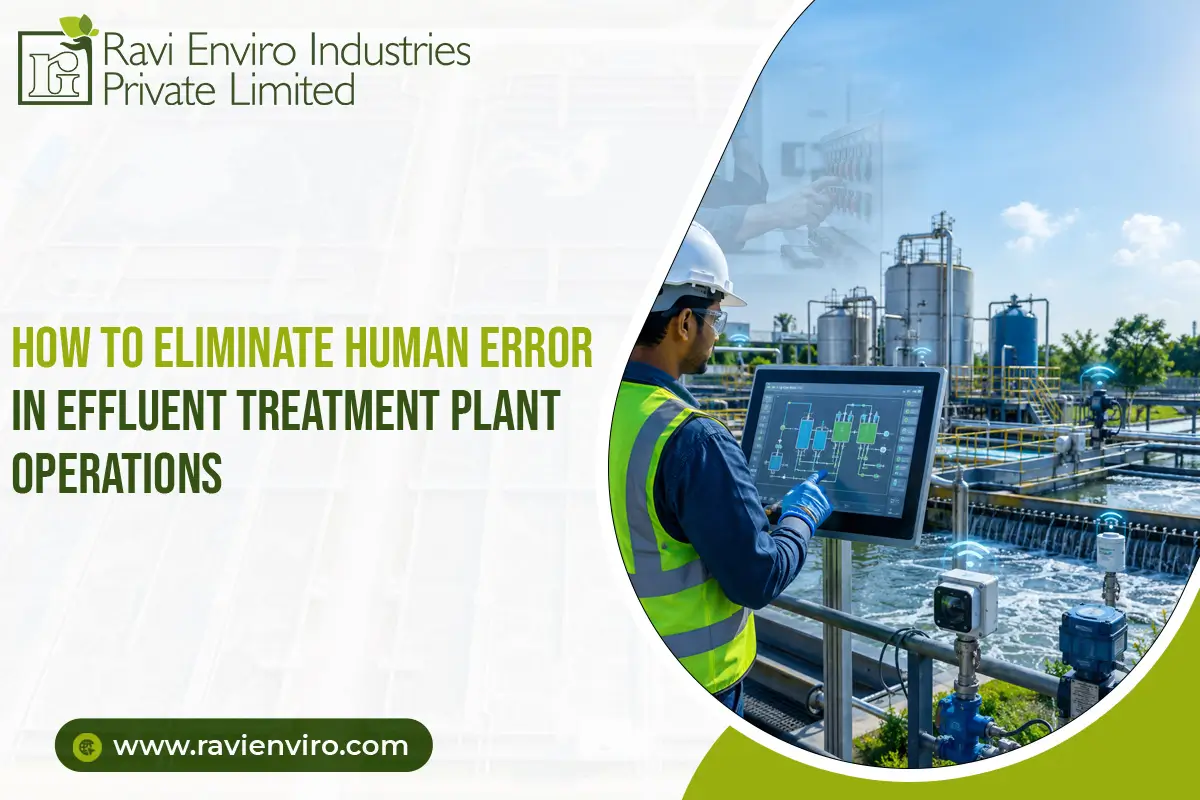
Automation is one of the most effective ways to reduce human error in an effluent treatment plant. Automated chemical dosing eliminates the guesswork and inconsistencies of manual dosing, ensuring chemicals are added accurately and at the right time. PLC- and SCADA-based control systems automate critical process sequences, provide continuous monitoring, and maintain detailed operational records. Also, purpose-built dosing skids further improve accuracy by delivering precise, repeatable chemical dosing without manual measurement.
4. Sensors & Monitoring in Real-Time
Real-time monitoring helps operators detect problems before they become critical. Sensors for pH, dissolved oxygen (DO), flow, and turbidity provide continuous process data, while PLC- or SCADA-based control systems generate instant alarms whenever parameters move outside the desired range. This gives operators early warning of developing issues, allowing corrective action before discharge limits are exceeded or treatment performance is affected.
5. Error-Proof With Interlocks & Clear Layout
A well-designed ETP should make mistakes difficult to make. Interlocks can prevent pumps from running dry, while automated controls can block chemical dosing when operating conditions fall outside preset limits. Clear labelling and colour-coded pipelines, valves, and equipment also help operators identify the correct components quickly and avoid costly errors.
6. Ensure Equipment Is Well Maintained
Many instances of “human error” are actually the result of equipment failures that force operators to react under pressure. A disciplined preventive maintenance routine keeps pumps, aerators, dosing systems, valves, and instruments operating reliably, reducing the need for risky manual interventions or temporary workarounds.
Conclusion
Eliminating human error in effluent treatment plant operations isn’t about demanding flawless operators; it’s about building a system that doesn’t depend on them being flawless. Clear procedures, ongoing training, automation of the error-prone tasks, real-time monitoring, error-proofing, and reliable maintenance ensure an ETP that stays compliant, runs stably, and protects both operators and its process.
As one of the best ETP plant manufacturers in India, Ravi Enviro Industries Private Limited offer ETP plants in manual, semi-automatic, and fully automatic configurations, with PLC and SCADA automation to take error-prone tasks out of human hands, precise dosing skids for reliable chemical dosing, and instrumentation for real-time monitoring. For existing plants, we provide revamping and retrofit spares to add automation and reliability, and structured operation and maintenance contracts with trained operators who run your plant to a professional standard. Whether you’re building a new effluent treatment plant or improving an existing one, we can help you build error resistance into every stage.
Frequently Asked Questions
Can human error in an ETP be completely eliminated?
Not entirely; people are part of every plant. But it can be reduced dramatically by designing operations so errors are prevented, caught early, and rarely consequential. Automation, instrumentation, SOPs, and training together get you close to error-free operation.
What is the most effective way to reduce ETP operator error?
Automation of error-prone tasks, especially chemical dosing and process control through PLC/SCADA systems, and online monitoring. These remove whole categories of manual error while giving operators real-time visibility to act early.
Does automation replace ETP operators?
No. Automation handles repetitive, precision, and monitoring tasks, freeing skilled operators to focus on judgement, response, and oversight. The best results come from combining trained people with automation, not replacing one with the other.
How do SOPs and checklists help?
They convert critical procedures into repeatable routines, so essential steps are never skipped or left to memory across shifts. Checklists in particular are a low-cost, high-impact way to prevent common errors during start-up, dosing, and handovers.
Can an existing ETP be upgraded to reduce human error?
Yes. Existing plants can be revamped with automation, dosing skids, instrumentation, and interlocks, and supported with O&M contracts and training, to significantly cut operational error without building a new plant.