- Aug 21, 2026
- Ravi Enviro
- STP
- 0 Comments
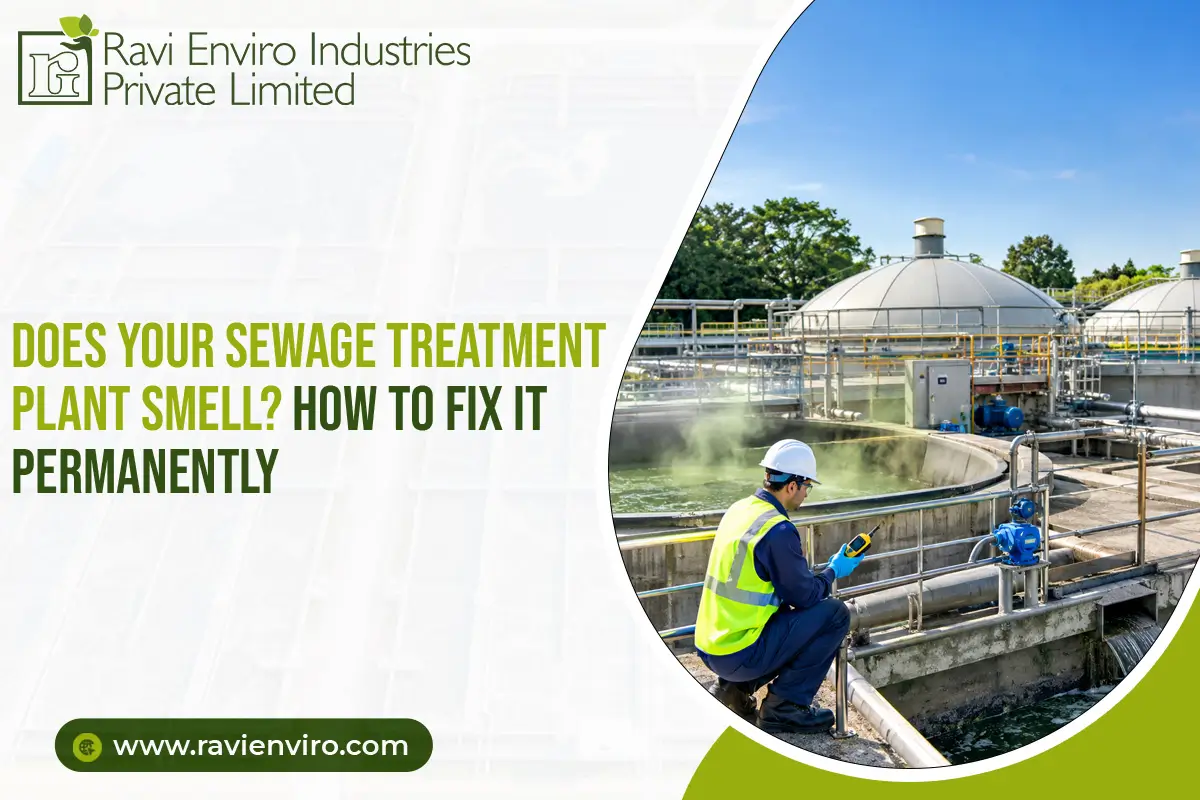
If your sewage treatment plant is smelly, it is a warning sign that your STP plant is not performing properly. Whether it is a domestic STP, an industrial STP or a hospital STP, these odours indicate problems, including excessive sludge growth, inadequate aeration or biological imbalance. So if your STP plant is generating persistent smells and is unaddressed, these odours can raise health concerns and regulatory violations. In this blog, we discuss what the odour in the STP plants is, why it happens and how to fix it permanently.
What is the Smell Coming From Sewage Treatment Plant?
The foul smell from the sewage treatment plant is mostly hydrogen sulphide, produced when the wastewater turns septic and oxygen runs out. Alongside it comes ammonia, mercaptans and various volatile organic compounds, each adding to the unpleasant mix. These gases form when organic matter is broken down by anaerobic bacteria, the microorganisms that take over whenever dissolved oxygen disappears. The fact that STO odour fundamentally is a sign of anaerobic conditions somewhere in the system is the key to the whole problem. Fix the oxygen and process problem, and the odour largely disappears on its own. Apart from causing nuisance, hydrogen sulphide is corrosive to concrete and metal, damaging your plant over time and posing a safety risk to operators at higher concentrations. At Ravi Enviro Industries Pvt.Ltd, as one of the top STP manufacturers in India, we can diagnose the problem behind foul smell in STPs and help ensure your facility is odour-free and completely compliant.
Why Does an STP Plant Smell Bad?
Before you can fix the smell permanently, you need to find where the anaerobic conditions are forming. The following are real root causes of STP odour:
- Insufficient Aeration & Low Dissolved Oxygen: This is one of the main reasons behind smelly sewage treatment plants. If blowers, diffusers or surface aerators are undersized, faulty or not running properly, the problem begins here. The dissolved oxygen in the aeration tank drops, anaerobic zones form and H2S is generated.
- Septic Incoming Sewage: If raw sewage sits stagnant in long collection lines or a sump for too long before treatment, it turns septic before it reaches the plant, arriving loaded with odour and sulphides.
- Poor Sludge Management: Sludge that is allowed to accumulate and sit in clarifiers, tanks, or thickened blanket goes anaerobic and becomes strong and a continuous source of odour.
- Hydraulic or Organic Overloading: When a plant receives more flow or a higher organic load than it was designed for, the biological treatment process becomes overloaded. Microorganisms can no longer break down pollutants efficiently, oxygen demand exceeds the available supply, and the system begins to shift into septic conditions. This often results in the formation of foul-smelling gases and persistent odour problems, while also reducing overall treatment efficiency.
- Dead Zones: Inadequate mixing leaves stagnant pockets where solids settle and go anaerobic. Even a well-aerated tank can smell if parts of it are not properly circulated.
Read: STP Maintenance Checklist
How to Fix STP Odour Permanently?
Permanent odour control means correcting the process, not masking the symptom.
1. Restore Proper Aeration & Dissolved Oxygen
The most effective way to control odours is to maintain proper aeration. Ensure that aeration equipment is correctly sized, routinely maintained, and operating consistently to provide sufficient oxygen throughout the treatment process. Maintaining a dissolved oxygen (DO) level of around 1.5–2.0 mg/L in the aeration tank supports healthy aerobic microbial activity and prevents the development of septic conditions. Whether using surface aerators or diffused aeration systems, consistent oxygen transfer keeps the biological process aerobic, significantly reducing the growth of odour-causing bacteria and the formation of foul-smelling gases.
2. Prevent Septicity Before Treatment
Stagnant sewage is one of the most common causes of odour. The longer wastewater sits in sumps, equalisation tanks, or pipelines, the greater the chance it will turn septic. Minimise detention time wherever possible. Use flow equalisation to maintain steady movement and pre-aerate incoming sewage to keep it oxygenated. These simple measures help keep the influent fresh, prevent foul-smelling gases from forming, and improve overall treatment performance.
3. Manage Sludge Properly
Handle sludge before it becomes a problem. Follow a regular desludging schedule and prevent excessive sludge blanket build-up. Dewater sludge promptly using equipment such as a screw press, which removes water efficiently and reduces the time sludge remains wet and unstable. Quick sludge handling prevents anaerobic conditions from developing and eliminates one of the biggest sources of odour in a treatment plant.
4. Eliminate Dead Zones with Proper Mixing
Adequate agitators and flash mixers keep solids in suspension and distribute oxygen evenly throughout the tank. This prevents stagnant zones from forming, where anaerobic conditions and odour-causing bacteria are most likely to develop.
Maintenance: The Solution to a Permanently Odour-free STP
Even a perfectly designed plant will start to smell if it’s not properly operated and maintained. Consistent aeration, regular sludge removal, routine cleaning of screens and surfaces, dissolved oxygen monitoring and prompt attention to equipment failures are what keep STPs odour-free year after year.
How Ravi Enviro Helps Fix Odour in Sewage Treatment Plants
Ravi Enviro Industries (REIPL), one of the leading sewage treatment plant manufacturers in India, has over five decades of experience designing, building, and maintaining sewage treatment plants across the country. When a plant smells, we look past the symptom to diagnose the underlying process problem, then fix it at the source. Our support includes a treatability study to pinpoint what’s going wrong, aeration, mixing, and sludge-handling equipment to correct it, VOC and odour-control systems for residual foul air, plant revamping where overloading is the issue, and O&M contracts to keep it that way. Whether you run a domestic, commercial, or industrial sewage treatment plant, we can help you make it permanently odour-free.
If your plant is smelling and you want it fixed for good, REIPL can diagnose the root cause and deliver a lasting solution.
Read: STP Requirements for Luxury Resorts and Eco-Tourism Projects
Frequently Asked Questions
Why does my sewage treatment plant smell like rotten eggs?
That smell is hydrogen sulphide, produced when the wastewater turns septic and runs out of oxygen. It means anaerobic conditions have formed somewhere in the plant, usually from insufficient aeration, sludge build-up, or overloading.
Can I just use odour-masking sprays or chemicals?
Only as a very short-term measure. Masking agents hide the smell temporarily and add running costs, but the odour returns as soon as they fade because the underlying anaerobic process is still active. Permanent control comes from correcting the process.
What is the most common cause of STP odour?
Insufficient aeration and low dissolved oxygen. When oxygen drops, odour-producing anaerobic bacteria take over. Restoring proper, consistent aeration is usually the single most effective fix.
Is STP odour dangerous?
Beyond the nuisance, hydrogen sulphide is corrosive to plant structures and equipment and can be a health and safety hazard to operators at higher concentrations, so persistent odour should be addressed promptly.
Can an existing smelly STP be fixed without full replacement?
In most cases, yes. A proper diagnosis often points to correctable issues, aeration, sludge management, mixing, or capacity, that can be resolved by upgrading equipment or revamping the existing plant rather than replacing it.