- Sep 22, 2026
- Ravi Enviro
- Effluent Treatment
- 0 Comments
Choosing an effluent treatment plant (ETP) manufacturer for your project is one of the most important decisions. An ETP is a major investment, and it should be able to properly treat wastewater, meet industry norms and run smoothly for years. The right manufacturer makes this possible. The wrong one can lead to poor treatment, penalties, and high costs. The best way to choose wisely is to ask the right questions before you decide. In this blog, we share 8 questions to ask an effluent treatment plant manufacturer for your project.
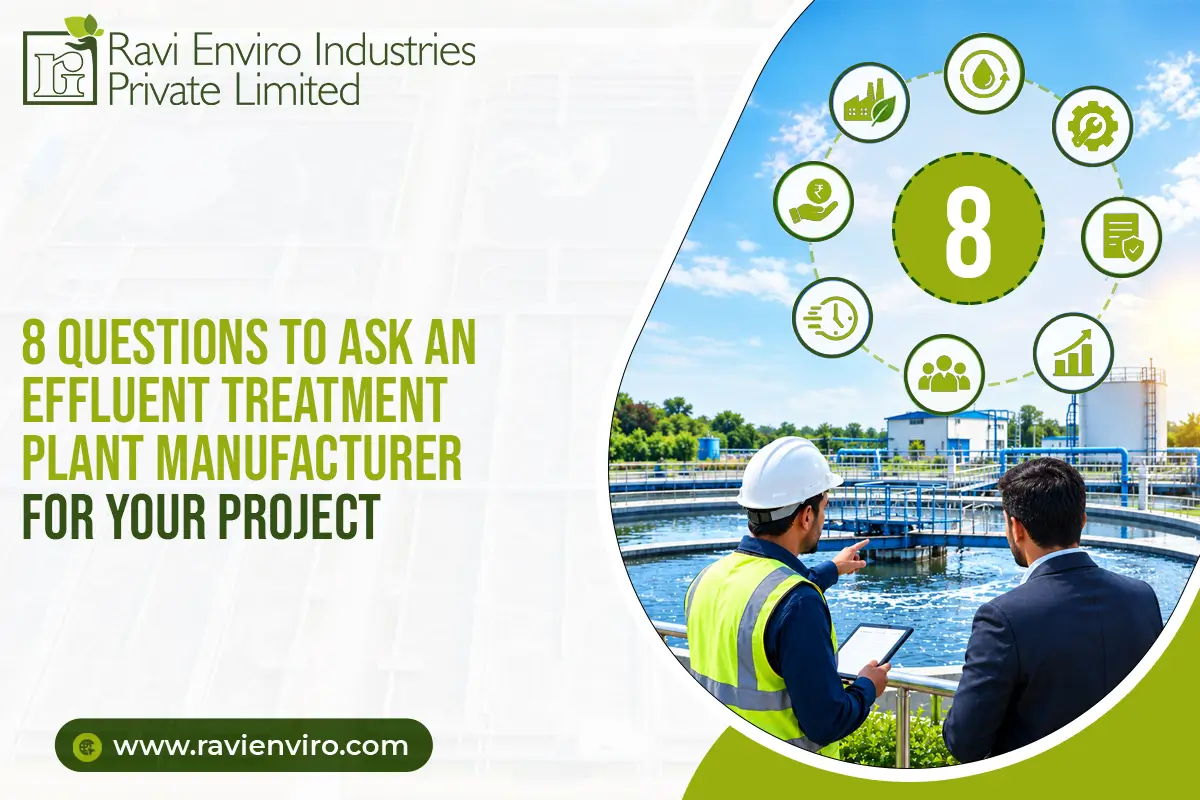
8 Questions to Ask an Effluent Treatment Plant Manufacturer for Your Project
1. Do You Have Experience with My Industry & Type of Effluent
Different industries produce different types of effluent. The wastewater from a textile unit is very different from that of a pharmaceutical, chemical, food, or dairy plant. Ask the ETP plant manufacturers in India has experience treating effluent similar to yours. A manufacturer who understands your type of wastewater is far more likely to design a plant that works well.
2. Will You Study My Effluent Before Designing the Plant?
A good ETP is designed around your actual wastewater, not a general design. To do this, the manufacturer needs to study your effluent first, including its flow and its characteristics. Ask whether they will analyse your effluent and carry out a proper study before designing the plant.
3. What Treatment Technology Do You Recommend & Why?
There are different technologies used in effluent treatment, and each suits different needs. Ask which technology they recommend for your effluent type, load, available space and the treated water quality.
4. Can You Ensure the Plant Meets Discharge & Compliance Standards?
Every industry must meet the discharge standards set by the Pollution Control Board. If the treated water does not meet these standards, you can face penalties or even a shutdown. Ask whether the plant will be designed to meet the required outlet standards for your industry, and how they will ensure this.
5. What Will the Plant Cost to Run?
The installation cost is only a part of the overall cost. An ETP also has running costs, including power, chemicals, and sludge disposal. A cheap plant to install can sometimes be expensive to run. Ask about the expected operating cost of the plant, as understanding this helps you compare options properly and avoid surprises later.
6. What Quality of Equipment and Materials Do You Use?
The quality of agitators, filters, and other equipment affects how well and how long the plant runs. Low-quality equipment breaks down often and needs frequent repairs. Ask what quality of equipment and materials they use, and whether it comes with a warranty. Good equipment lasts longer and lowers your long-term costs.
7. Do You Provide Installation, Commissioning, and After-Sales Support?
Building the plant is only the beginning. It must be installed, commissioned, and then operated and maintained properly. Ask whether the water treatment plant company in India provides full installation and commissioning, operator training, and after-sales support such as maintenance services and spare parts. Ongoing support keeps your plant running well for years.
8. Can You Share Past Projects?
A trusted manufacturer will have a track record. Talking to past customers or seeing completed projects tells you a lot about their reliability and quality.
Conclusion
Choosing an effluent treatment plant manufacturer is a decision that affects your operations for years to come. By asking these eight questions, you can look past the sales talk and find a manufacturer who truly understands your needs. At Ravi Enviro Industries Pvt.Ltd, one of the top ETP suppliers in India, we support effluent treatment plants for industries across many sectors, and we can answer every one of these questions with confidence.
If you are planning an effluent treatment plant for your project, contact REIPL today for expert guidance and a solution built around your needs.
Read: Effluent Treatment Plant (ETP): Meaning & Process
FAQs
1. What should I ask before choosing an ETP manufacturer?
Ask about their experience with your type of effluent, whether they will study your wastewater before designing, the technology they recommend, how they will meet compliance standards, the running cost, equipment quality, after-sales support, and references from past projects.
2. Why is it important that the manufacturer studies my effluent first?
Because a good ETP is designed around your actual wastewater. Studying your effluent’s flow and characteristics allows the manufacturer to design a plant that treats it properly, rather than using a general design that may not suit your needs.
3. Why does after-sales support matter for an ETP?
An ETP needs proper operation and maintenance to keep working well. A manufacturer who provides installation, commissioning, training, and ongoing support helps ensure your plant runs reliably for years.
4. How do I choose an ETP manufacturer in India?
Compare the manufacturer’s industry experience, wastewater analysis process, treatment technologies, compliance approach, equipment quality, operating costs, installation capabilities, after-sales service and previous projects.
5. What information does an ETP manufacturer need before designing a plant?
The manufacturer generally needs information about wastewater flow, effluent characteristics, pollutant levels, operating conditions, required treated-water quality and applicable discharge requirements. Actual requirements vary by industry and project.
6. How much does an ETP cost to operate?
ETP operating costs depend on factors such as wastewater flow, treatment technology, electricity consumption, chemical requirements, sludge generation, manpower and maintenance. The manufacturer should provide an estimated operating cost for the proposed design.
7. Why should I compare ETP manufacturers based on operating cost?
Because the initial installation price is only part of the total cost. A plant with higher power, chemical, maintenance or sludge-disposal requirements can have greater long-term operating expenses.
8. What should I check in an ETP manufacturer’s previous projects?
Look for projects with similar wastewater characteristics, industry applications, treatment capacity and required treated-water quality. Where possible, ask for project references and understand the manufacturer’s role in design, installation and commissioning.
9. What after-sales services should an ETP manufacturer provide?
Depending on the project, useful support can include commissioning, operator training, preventive maintenance, troubleshooting, spare-parts support and periodic technical assistance.