- Oct 22, 2026
- Ravi Enviro
- ETP Plant
- 0 Comments
In a small or medium-sized factory, wastewater comes from the production line, from washing and cleaning, and from just about any other process that uses water. This effluent may contain suspended solids, organic matter, oil, chemicals and other pollutants that require treatment before discharge or reuse. For MSMEs, wastewater management can be challenging because of limited space, smaller treatment capacities and controlled operating budgets.
A compact Effluent Treatment Plant (ETP) can address these challenges through a space-efficient treatment system. Choosing experienced ETP suppliers in India can help MSMEs select a solution based on wastewater characteristics, available space and treatment requirements. Ravi Enviro Industries Pvt. Ltd. provides packaged and pre-fabricated wastewater treatment solutions for different industrial applications.
Why Do MSMEs Need an ETP?
An ETP treats industrial wastewater before it’s discharged or sent back for reuse. Sewage from a house is more or less the same everywhere; factory wastewater isn’t. A textile unit sends out dyes and salts, a food plant sends out oil and organic load, and an electroplating shop sends out heavy metals. So the pollutants differ from one industry to the next: BOD, COD, suspended solids, oil and grease, and whatever chemicals the process uses. A well-designed ETP brings these down so the treated water meets the discharge or reuse limits that apply to you. For MSMEs, selecting an ETP is therefore not simply about installing a treatment unit. The system should match the factory’s wastewater flow, quality and treatment objectives.
When evaluating effluent treatment plant suppliers in India, businesses should consider whether the supplier can assess their effluent and develop a suitable treatment configuration rather than offering a standard solution for every industry.
What Is a Compact ETP?
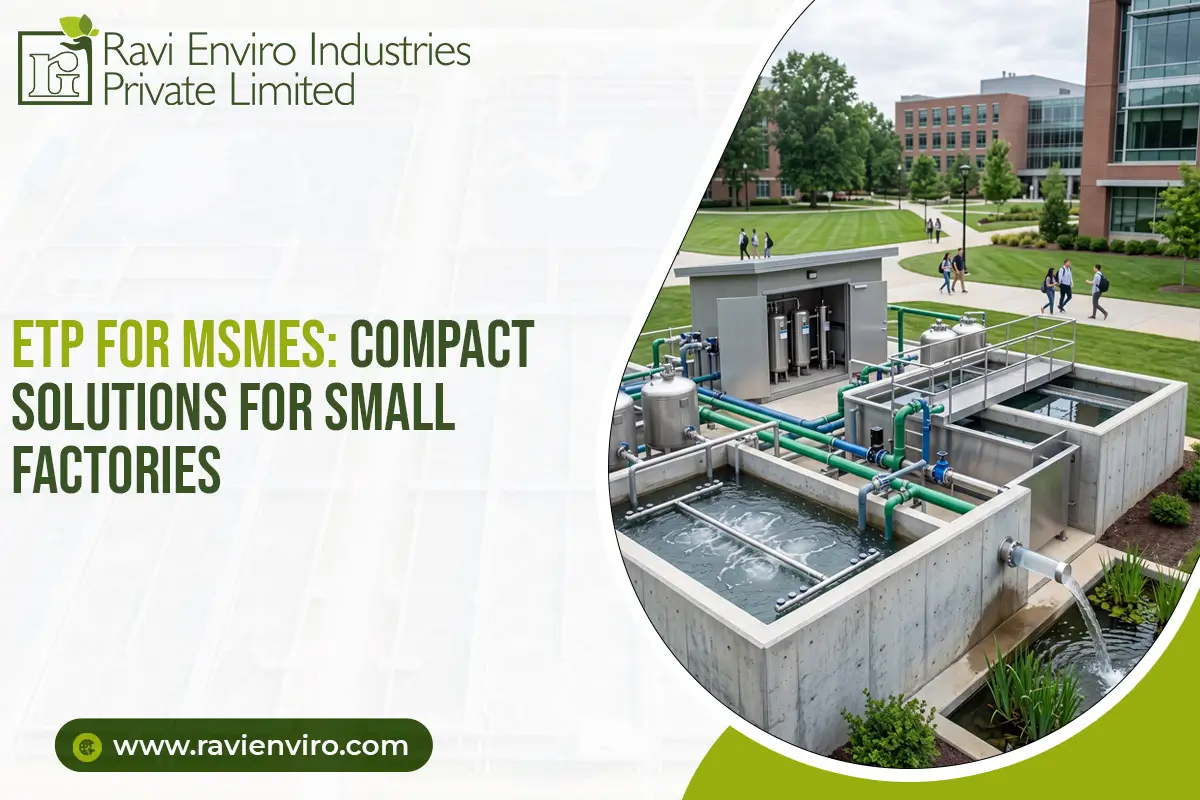
A compact ETP is a space-efficient wastewater treatment system designed to handle a specific industrial effluent flow within a relatively smaller footprint. It can combine multiple treatment stages into a packaged, pre-fabricated or skid-mounted configuration.
This approach is useful for MSMEs with limited land or comparatively lower wastewater volumes. Depending on the application, a compact ETP may incorporate physical, chemical and biological treatment processes.
Ravi Enviro Industries Pvt. Ltd. offers packaged ETP solutions, including pre-fabricated and skid-mounted systems for smaller capacities. These configurations can simplify ETP installation and reduce the need for extensive site construction.
How Does a Compact ETP Work?
The exact treatment process depends on the type and quality of industrial effluent. A typical system may include:
- Preliminary treatment: Wastewater first passes through screens, which catch the larger solids and debris before they can damage pumps or clog later stages.
- Equalization: Flow and pollutant load rarely stay constant through the day, so the wastewater is collected in a tank and mixed. This evens out the swings before it moves on.
- Chemical treatment: Coagulation and flocculation help pull out fine suspended and colloidal particles. A flash mixer blends the chemicals in quickly and evenly.
- Biological treatment: Systems like MBBR or SBR let bacteria break down the biodegradable organic matter. Aeration keeps those bacteria supplied with oxygen.
- Clarification: The water is left to settle, so suspended solids and biological sludge sink out and clearer water is left on top.
- Filtration: If you need cleaner water than settling can give, a filtration or polishing step is added at the end.
- Sludge management: All the sludge collected along the way has to be dealt with. It usually needs thickening, dewatering and proper handling or disposal.
This makes proper ETP design essential. Treatment stages should be selected according to wastewater characteristics, flow rate and the intended discharge or reuse application.
Benefits of Compact ETPs for MSMEs
Compact ETPs can offer several practical advantages for smaller industrial facilities.
Space efficiency: A smaller footprint can make treatment more practical where factory land is limited.
Suitable capacity: MSMEs can select a system according to their actual wastewater generation instead of installing an unnecessarily large plant.
Simplified installation: Pre-fabricated and packaged systems can reduce civil construction requirements and simplify ETP installation.
Flexible configuration: There’s no fixed template. The treatment stages are chosen based on what’s in your effluent and the water quality you need at the end.
Water reuse potential: If the treated water reaches the required quality, it can often go back into non-potable uses like cooling, washing or gardening. That means less freshwater drawn in.
Easier day-to-day operation: Automation takes a lot of the routine monitoring off your team’s hands. It doesn’t replace upkeep, though. An ETP still needs regular operation and maintenance to keep performing well.
Future scalability: Expected increases in production and wastewater generation can be considered during initial plant selection and design.
How to Choose the Right Compact ETP for Your Factory
Choosing a compact ETP should begin with the factory’s wastewater rather than simply its budget or available space. MSMEs should consider:
Wastewater flow: Determine average and peak wastewater generation, generally measured in KLD or cubic metres per day.
Effluent characteristics: Parameters such as pH, BOD, COD, TSS, oil and grease, TDS and industry-specific pollutants should be assessed.
Industry type: Textile, food-processing, pharmaceutical, chemical and engineering facilities can require different treatment approaches.
Available space: The layout should provide adequate room for treatment units, access, maintenance and sludge handling.
Treated-water requirement: The discharge route or intended reuse application determines the required treatment quality.
Operating requirements: Chemical consumption, power, automation, manpower and maintenance should be considered.
Future expansion: Expected increases in production should be considered during ETP design.
Working with experienced ETP manufacturers in India can help MSMEs evaluate these factors and select a system suited to their operating conditions. Ravi Enviro Industries Pvt. Ltd. provides water and wastewater treatment solutions along with design, manufacturing, installation, commissioning and operation and maintenance support.
FAQs
1. Which components support compact ETP performance?
Components depend on the treatment process selected for the wastewater. An agitator provides controlled mixing within treatment tanks, while a flash mixer enables rapid and uniform mixing of chemicals during coagulation. Other components may include clarifiers, filters, aeration equipment and sludge-dewatering systems.
2. What is the BOD limit for ETP water?
There’s no single BOD limit for every industrial ETP. It depends on the discharge route and the industry’s standards. For inland surface water, the CPCB’s general limit is 30 mg/L (3 days at 27°C). MSMEs should confirm the exact requirement with their Pollution Control Board and make sure their industrial wastewater treatment plant is designed to meet it.
Ravi Enviro Industries Pvt. Ltd. offers customised and packaged wastewater treatment solutions, including ETP design, installation, and operation and maintenance.