- Oct 22, 2026
- Ravi Enviro
- MBR
- 0 Comments
Factory wastewater is rarely simple. It can carry organic matter, suspended solids, chemicals, oils and other pollutants, and all of it has to be treated before the water is discharged or reused. Many plants also can’t spare much floor space for a treatment system, which is why Membrane Bioreactor (MBR) technology has been getting more attention.
An MBR brings biological treatment and membrane filtration together in one process. In a conventional setup, the water goes through biological treatment and then to a secondary clarifier, where the solids settle out. An MBR uses membranes for that last step instead. The treated water is more consistent, and the system fits into a much smaller footprint.
What Is a Membrane Bioreactor (MBR)?
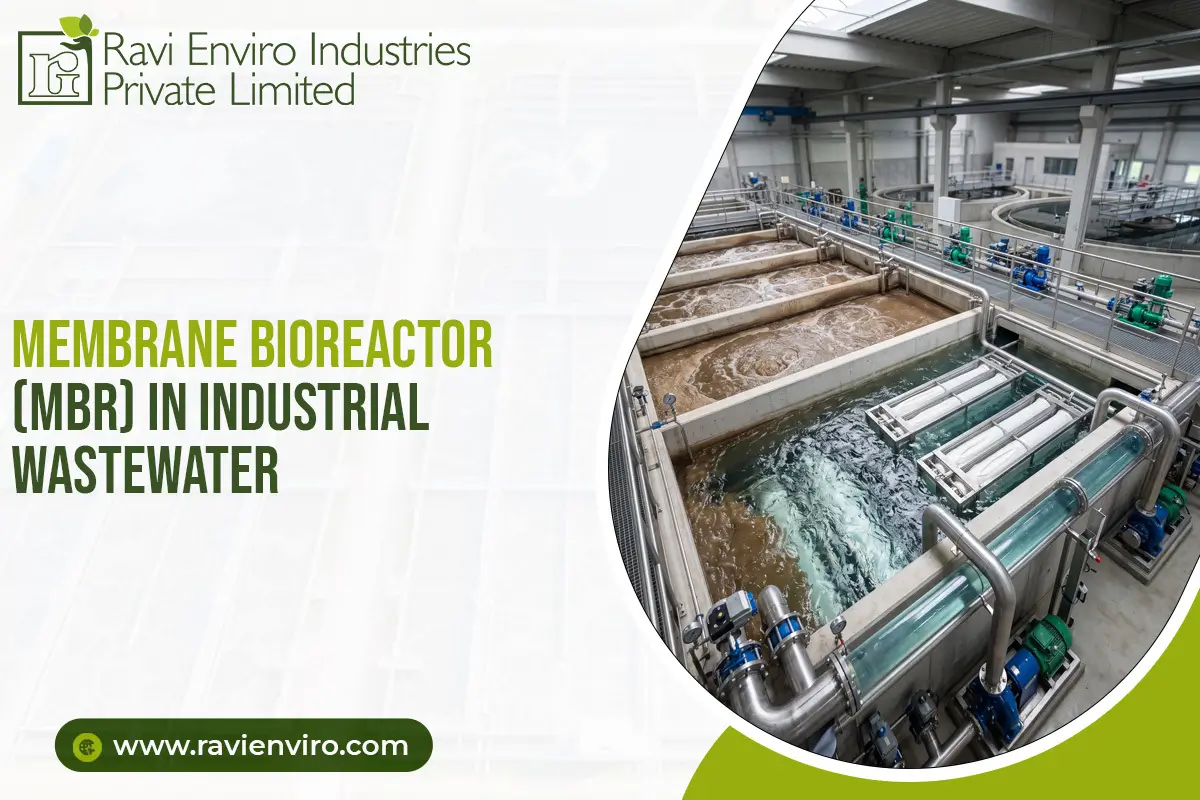
A Membrane Bioreactor is a wastewater treatment technology that combines an activated sludge biological process with membrane separation. Microorganisms break down biodegradable pollutants, while membranes separate treated water from suspended solids and microorganisms.
The membrane unit generally uses microfiltration or ultrafiltration membranes. This is why an MBR can sometimes be associated with an ultra filtration water treatment plant, although the two are not identical. Ultrafiltration can be used as the membrane separation stage within an MBR system.
The membranes retain biomass and fine suspended particles, allowing the treated water to pass through. This eliminates or reduces the need for a conventional secondary clarifier in the main separation stage.
How Does an MBR System Work?
The MBR process generally involves several stages. The exact configuration depends on the wastewater characteristics and required treated-water quality. Ravi Enviro Industries Pvt. Ltd. considers these factors when developing MBR-based wastewater treatment solutions, so the treatment stages can be matched to the specific industrial application.
1. Preliminary Treatment:
Screens or other pretreatment equipment remove larger solids and debris that could damage or foul the membranes.
2. Biological Treatment:
Wastewater enters a bioreactor where microorganisms consume biodegradable organic pollutants. Aeration supplies oxygen and helps maintain the biological process.
3. Membrane Separation:
After biological treatment, the mixed liquor passes through membrane modules. The membranes retain suspended solids, bacteria and biomass while allowing treated water to pass through.
4. Sludge Management:
Excess biological sludge is periodically removed from the system. Proper sludge handling is important for maintaining stable biological conditions and membrane performance.
5. Treated-water Discharge or Reuse:
Depending on the treatment objectives and additional polishing requirements, the permeate can be discharged or considered for suitable non-potable reuse applications.
Why Use MBR for Industrial Wastewater Treatment?
Industrial facilities often have limited space and varying wastewater characteristics. An MBR can address some of these challenges through its combination of biological treatment and membrane separation.
Compact Footprint
Because membrane separation replaces the large settling area required by conventional secondary clarification, MBR systems can be designed with a relatively smaller footprint. This can be useful for industries where available plant space is limited.
Better Solids Separation
The membrane barrier retains suspended solids and microorganisms more effectively than conventional settling alone. This can result in a clearer treated-water stream when the system is correctly designed and operated.
Higher Biomass Concentration
MBR systems can operate with higher mixed liquor suspended solids concentrations than many conventional activated sludge systems. This allows biological treatment to take place in a comparatively smaller reactor volume.
Consistent Treated-Water Quality
The membranes act as a physical barrier, holding back suspended solids and microorganisms. That’s why an MBR tends to give a steadier effluent quality than systems that rely on settling alone. How well it performs in your plant still depends on a few things: what’s in the wastewater, which membrane is chosen, how the system is operated, and how well the water is pretreated beforehand.
MBR vs Conventional Wastewater Treatment
A conventional biological treatment system commonly uses a secondary clarifier to separate treated water from biological sludge. MBR technology performs this separation using membranes instead.
This difference can provide several operational advantages, particularly where space is restricted or higher-quality treated water is required. However, MBR systems also require careful control of membrane fouling, aeration, cleaning and sludge characteristics.
For industries comparing these two approaches, the choice should be based on wastewater characteristics, required effluent quality, available space, energy requirements and operating conditions rather than simply choosing the newer technology.
Ravi Enviro Industries Pvt. Ltd. can help industries assess these factors when comparing MBR with conventional treatment configurations. The appropriate solution may vary depending on the type of effluent, treatment capacity, discharge requirements and whether the treated water is intended for reuse.
What Should Industries Consider Before Installing an MBR?
Selecting an MBR requires more than choosing membrane equipment. The wastewater should first be characterised for parameters such as BOD, COD, TSS, pH, oil and grease, nutrients, salinity and industry-specific contaminants.
Pretreatment is particularly important because excessive solids, oil, grease or other contaminants can increase membrane fouling. Hydraulic flow, peak loads, required treated-water quality, available space, energy consumption and sludge production should also be considered.
Working with experienced ETP suppliers in India can help industries evaluate these factors before finalising the treatment configuration. A supplier should be able to assess the wastewater and recommend a system based on actual treatment requirements rather than applying the same configuration to every industry.
MBR for Industrial Wastewater Treatment: Is It Suitable for Every Industry?
MBR can be considered for industries that require compact biological treatment and reliable solids separation, particularly when treated water quality or space limitations are important considerations.
However, industrial wastewater can vary significantly between sectors. Food processing, pharmaceuticals, textiles, chemicals and other manufacturing facilities may have very different pollutant profiles. Some applications may require chemical treatment, advanced filtration, RO or other processes before or after the MBR stage.
This is why choosing experienced ETP manufacturers in India is important when planning an MBR-based industrial wastewater treatment plant. The system should be engineered around the industry’s wastewater characteristics, treatment targets and operating conditions.
Conclusion
An MBR puts biological treatment and membrane filtration in one system. The membranes do the solids separation that a clarifier would normally handle, so the whole setup takes up less room. That makes it worth a look if your plant is short on space, or if the treated water has to meet a tough standard.
It isn’t a plug-and-play fix, though. How well an MBR works comes down to the basics: the process design, the choice of membrane, pretreatment, aeration, cleaning, and how well the plant is run and maintained afterwards. Skip any of those and the system will struggle.
Not sure whether MBR suits your plant? Water treatment plant suppliers in India can help you work that out. Sometimes the answer is MBR on its own, and sometimes it works better combined with other treatment stages.
At Ravi Enviro Industries Pvt. Ltd., we build industrial water and wastewater treatment solutions around the application, not a fixed template. Before finalising any system, we look at the wastewater itself, the flow, the space available, the regulatory requirements and what the treated water will be used for.