- Jul 17, 2026
- Ravi Enviro
- Effluent Treatment
- 0 Comments
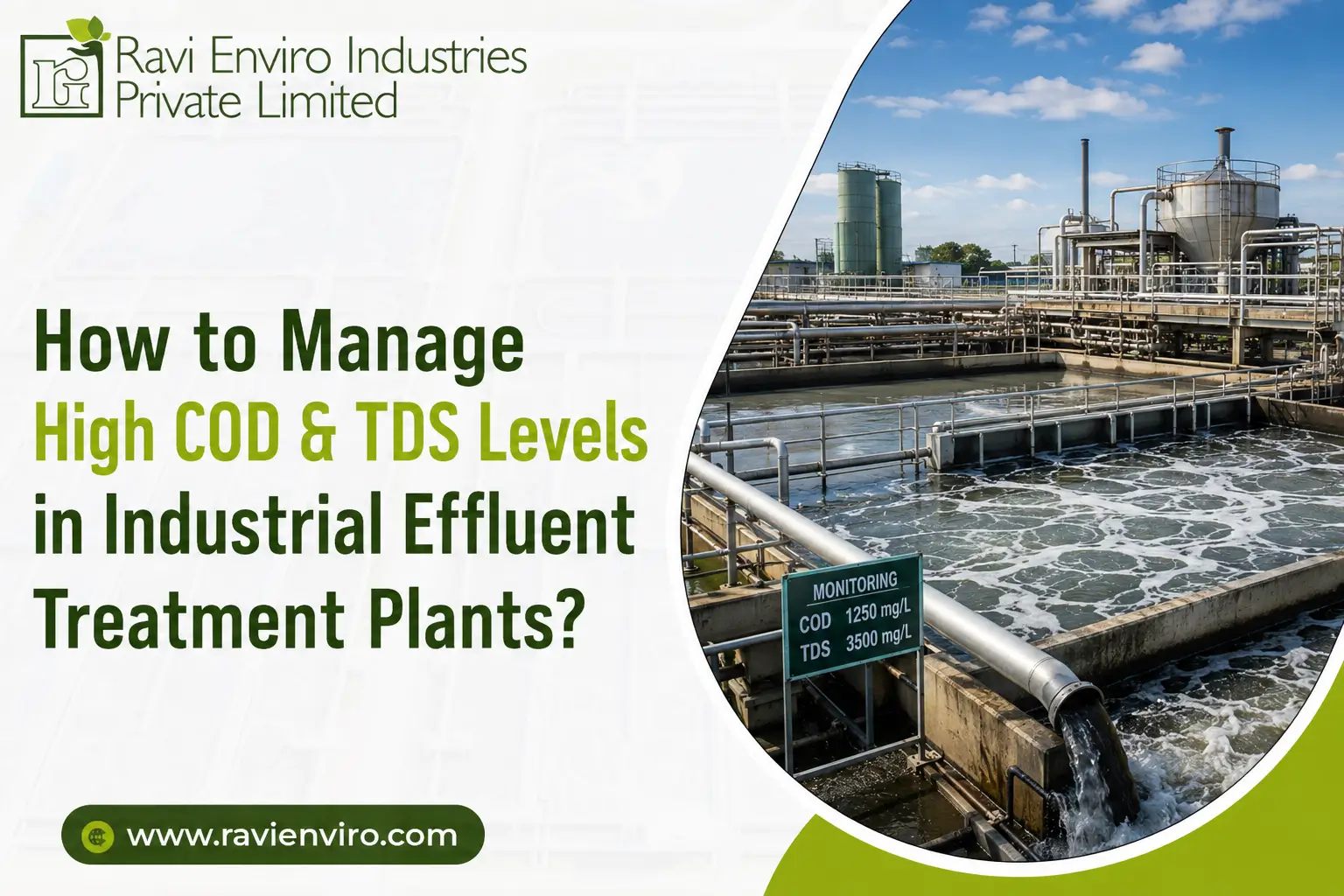
For industrial water treatment plant facilities, Chemical Oxygen Demand (COD) and Total Dissolved Solids (TDS) are two of the most important parameters in effluent treatment plants (ETPs). When these values increase, the sequences range from SPCB (State Pollution Control Boards) violation notices to receiving water-body damage to complete showdown orders. High COD typically comes from solvents, dyes, food waste, dairy, pharmaceuticals and other effluents. While high TDS result from bleaching agents, neutralization chemicals and other contaminants. In this blog, we at Ravi Enviro Industries Private Limited explore how to manage high COD & TDS levels in industrial effluent treatment plants to ensure your facility meets compliance standards.
How can industries reduce high COD and TDS in an ETP?
High COD is reduced through equalization, coagulation, anaerobic and aerobic biological treatment, while high TDS is controlled using membrane technologies like RO, evaporation, crystallization, or Zero Liquid Discharge (ZLD). The right treatment sequence depends on the industry, wastewater characteristics, and discharge standards.
Understanding COD & TDS in Industrial Wastewater
What is Chemical Oxygen Demand (COD)?
Chemical oxygen demand measures the total quantity of oxygen required to chemically oxidise all organic and inorganic matter present in effluent. High COD signals a heavy organic pollution load that depletes dissolved oxygen in receiving water bodies, causing aquatic toxicity.
What is Total Dissolved Solids (TDS)?
Total dissolved solids measure the total concentration of dissolved organic salts, minerals, metals and ionic compounds in effluent. High TDS makes treated water unsuitable for reuse, clogs RO membranes and makes the soil infertile if applied to land.
Key Distinction Between COD and TDS
COD and TDS require fundamentally different treatment approaches. COD is primarily reduced through biological and chemical oxidation processes. TDS cannot be biodegraded; it must be physically separated through membrane filtration, evaporation or crystallisation. An ETP designed only for COD reduction will fail its TDS targets, vice versa.
Root Causes of High COD & TDS in Industrial Effluents
| Industry | Primary COD Source | Primary TDS Source |
| Pharmaceuticals | Solvents, API, fermentation residues | Process salts, buffer solutions, acid/alkali neutralisation |
| Textiles & dyes | Dye auxiliaries, sizing agents, surfactants | Sodium chloride from dyeing, sodium sulphate from printing |
| Dairy & beverages | Lactose, fats, proteins, BOD-rich washings | Cleaning-in-Place (CIP) chemicals, brine |
| Chemical manufacturing | Organic intermediates, reaction by-products | Inorganic salts, neutralisation, process water |
| Food Processing | Starch, sugars, fats, vegetable matter | Brine from washing, sodium from additives |
| Petrochemicals | Hydrocarbons, phenols, complex organics | Dissolved minerals, process condensates |
| Fertiliser plants | Ammonia nitrogen | Nitrates, sulphates, phosphates |
How to Manage High COD & TDS Levels in Industrial Effluent Treatment Plants
As one of the leading ETP plant manufacturers in India, we emphasize effective COD and TDS management through a carefully sequenced treatment plan.
1. Equalisation & Primary Treatment
The equalisation tank is the first and the most underestimated defence against COD spikes. Proper retention time (typically 6–24 hours, depending on batch nature), buffer flow and load variations, protecting downstream biological stages from shock loading. Primary clarifiers and API/TPI separators remove free oils, suspended solids and floating matter that would otherwise impose a false COD load.
2. Chemical Treatment (pH Correction & Coagulation)
Before biological treatment, pH must be corrected to 6.5–8.5 for optimal microbial activity. Coagulation using alum, ferric chloride or polyelectrolytes followed by flocculation removes colloidal particles and colour, reducing COD by 20–40% and preparing the effluent for biological stages. For high-sulphate streams (common in textiles), careful pH management prevents H₂S formation in anaerobic reactors.
3. Anaerobic Biological Treatment
For inlet COD above 2,000 mg/L, anaerobic treatment is not optional; it is essential. The Upflow Anaerobic Sludge Blanket (UASB) reactor is the most widely deployed technology for high-strength industrial effluents in India. It can reduce COD by 60–70% while simultaneously generating biogas (methane) that can offset plant energy costs. UASB is ideal for pharmaceutical, dairy, and food industry effluents with readily biodegradable organic loads.
4. Aerobic Biological Treatment
Aerobic treatment follows anaerobic pre-treatment to bring residual COD to discharge standards. REIPL reploys three primary aerobic technologies depending on effluent characteristics and space availability. Moving Bed Biofilm Reactor (MBBR) is preferred for variable loads and compact installations. The Sequential Batch Reactor (SBR) offers superior nutrient removal with minimal footprint. Membrane Bioreactor (MBR) delivers the highest effluent quality, with treated water suitable for direct process reuse, eliminating a separate tertiary filtration stage.
5. TDS Reduction
TDS reduction begins in earnest at this stage. Biological treatment does not reduce dissolved salts; dedicated membrane or thermal processes are required. For moderate TDS (up to 5,000–8,000 mg/L), an Industrial RO System can achieve 70–85% TDS rejection, with permeate reused in the process and concentrate sent to further treatment.
6. Tertiary Treatment & Sludge Management
Tertiary treatment ensures final polishing of COD, colour, suspended solids, and residual contaminants before discharge. Sand and activated carbon filters remove trace organics and colour. Disinfection with chlorine or UV completes pathogen removal. Sludge generated across all stages must be dewatered using a Screw Press or filter press and managed in compliance with Hazardous Waste Management Rules. A Dregz Dryer can further reduce sludge volume for cost-effective disposal.
Why Choose Ravi Enviro Industries?
- 53+ years in industrial wastewater treatment
- Hundreds of successful installations
- Customized STP, ETP, RO, UF & ZLD systems
- Experienced design and commissioning team
- PAN India installation & service support
- High-quality components from trusted brands
Is Your ETP Struggling with High COD or TDS?
Managing high COD and TDS requires a well-designed treatment strategy that combines biological, chemical, and membrane technologies. By identifying the root causes of contamination and selecting the appropriate treatment process, industries can achieve regulatory compliance, improve water reuse, lower operating costs, and protect the environment. Regular ETP performance audits and timely system upgrades ensure long-term operational efficiency and sustainable wastewater management.
If your ETP was installed more than 8–10 years ago, or if production volumes and product mix have changed significantly, a formal plant audit and revamping assessment from REIPL can identify specific upgrades, adding a stage, replacing equipment, or re-sequencing the treatment train that restores compliance at a fraction of the cost. REIPL’s engineering team has resolved high-COD and high-TDS challenges across pharmaceuticals, textiles, dairy, chemicals, and food processing for over five decades. Call us for more information.
Frequently Asked Questions (FAQs)
What is the permissible COD limit for industrial effluent discharge in India?
As per CPCB General Standards, the permissible COD limit for effluent discharge into inland surface water is 250 mg/L. For discharge into public sewers, the limit is also 250 mg/L, while for land disposal and irrigation, the limit is stricter at 100 mg/L. State Pollution Control Boards may impose tighter limits depending on the receiving water body and industry type. Always verify your Consent to Operate (CTO) conditions for applicable standards.
What is the acceptable TDS limit for industrial effluent in India?
The CPCB General Standard for TDS in industrial effluent discharge is 2,100 mg/L for inland surface water. For marine coastal areas, a 600 mg/L net increase is the applicable limit. Pharmaceutical and food industries often face stricter sector-specific standards issued under their respective environmental guidelines. In water-stressed regions, ZLD mandates effectively set TDS limits at near-zero for the liquid discharge stream.
Which biological treatment technology works best for high-COD industrial effluent?
For very high COD above 3,000 mg/L, UASB (Upflow Anaerobic Sludge Blanket) reactors are the preferred first stage, achieving 60–70% COD reduction while generating recoverable biogas. This is followed by aerobic polishing using MBBR or SBR to reach final discharge standards below 250 mg/L. The combined anaerobic-aerobic approach significantly reduces aeration energy costs compared to aerobic-only systems, often yielding 30–40% lower operating costs for high-strength influents.
How to reduce TDS in an effluent treatment plant?
Reducing Total Dissolved Solids (TDS) in Effluent Treatment Plants (ETP) Sustainable Industrial requires a multi-stage approach, often starting with source control before relying on advanced treatment technologies like Reverse Osmosis (RO).
How to reduce COD in effluent?
To reduce Chemical Oxygen Demand (COD) in wastewater, combine primary physical separation (screening and sedimentation), biological degradation (aerobic/anaerobic processes), and chemical polishing (ozonation or advanced oxidation). This multi-stage approach ensures you break down and remove both biodegradable and complex, non-biodegradable organic pollutants.
What is the COD limit for industrial wastewater?
There is no single universal Chemical Oxygen Demand (COD) limit for industrial wastewater. Limits vary depending on your location, the specific industry sector, and whether the water is discharged into a municipal sewer or directly into surface water.
What happens if TDS is too high in water?
High Total Dissolved Solids (TDS) in water-levels above 500 mg/L-typically cause unpalatable taste (salty, bitter, or metallic), dry hair and skin, and stubborn mineral scaling on pipes and plumbing fixtures. If levels surpass 1,200 mg/L, the water is generally considered unsafe for consumption without treatment.